Nobody trained me for this
When you lead a hundred people and two of them are in crisis, the organisation expects you to hold it all. Nobody asks who holds you.
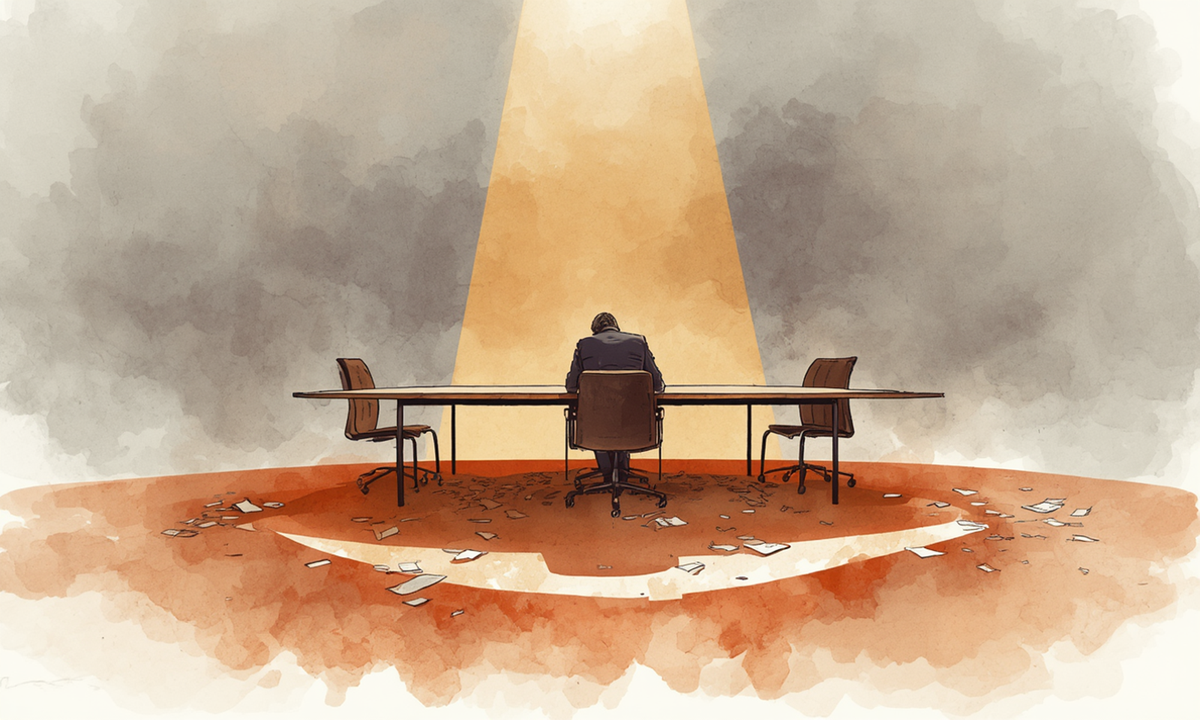
There is a moment when it stops being management. You don't always recognise when it happens.
You learn how to set objectives, how to run performance reviews and how to deliver feedback that is firm but fair. You read the books. Attend the workshops. You become fluent in the vocabulary of leadership: coaching, alignment, psychological safety. You take the job seriously, you take pride in developing others and commit to longer running leadership programmes to deepen your capabilities. And then one day, someone in your team sends you a photograph of a dead dog at two in the morning and you realise that none of it applies.
I lead more than a hundred people across multiple countries. Not all my direct reports of course, but functionally I am overseeing them all. It's fast-paced work that crosses cultures, time zones, regulations and expectations. I've written before about what that does to my own nervous system sometimes. How the calm composure people see is often a sort of shutdown. Numbness in a suit.
But this piece isn't about me. Or actually, it is, but from the other side. The side where you're not managing your own wounds but standing in front of someone else's, and the organisation has given you nothing to stand on.
Two people, two countries
I want to tell you about two situations I've faced. Different countries, different people, different presentations.
The first was a man. Middle-aged, experienced, entrepreneurial and a loud, bombastic presence. He was well liked in the beginning, but performance issues soon started to show through the cracks.
What I noticed first wasn't the performance itself but the entitlement underneath it. A sense that consequences were for other people. That rules applied loosely, if at all. Feedback landed on the surface and slid off. Accountability was met not with defensiveness exactly, but with a kind of cheerful dismissal, as if the conversation hadn't happened. And when that didn't work, the aggression would come. Not direct, never quite direct, but sideways. A shift in tone. A comment with an edge buried in humour. The kind of thing that makes you pause and wonder if you imagined it.
My body registered it before my mind did. A tightness in my chest before meetings. A low-grade vigilance I couldn't explain. I started changing my behaviour around him without fully realising it. I began documenting conversations I would normally have let pass. Writing down times and dates. Saving messages. Not because I had a plan, but because something in me was building a case that my rational mind hadn't yet approved.
The performance issues turned into a longer sick leave. The system in that country was structured: occupational physician, reintegration plan, mandated timelines. What matters here is what happened underneath the process.
His drinking problem was invisible to me at the time. I don't know when it started, or whether it had always been there underneath the bombast. What I know is that while he was still officially on sick leave, the messages started. Late at night. Pictures of him with women in bars, accompanied by rambling texts. And one night - I will for the love of me never forget this - a photograph of a dead dog on the floor in a blanket. Sent to me as a visual explanation for why he couldn't make his appointment with the company doctor the next morning. As if sharing it with your manager was a perfectly normal thing to do. As if sharing it in the middle of the night was perfectly normal at all.
I remember staring at the image and feeling something shift. Not anger, exactly. It was the realisation that I had been managing a surface - performance plans, reintegration steps, careful conversations - while something entirely different was happening underneath. The framework had done its job. It had given him time, space, medical oversight, legal protection. But it couldn't reach the part of him that was sending photographs of dead animals to his manager at two in the morning.
The dismissal, when it finally came, was not accepted. He refused to return his company car. Refused to hand in his devices. Refused, in any meaningful sense, to acknowledge that it was over. That the court ruled in the company's favour was put completely aside. Our lease department hopped in the train with the spare key, walked down his street until the key responded, and took the car. We had to involve the police. I remember standing in my kitchen, on the phone with HR and law enforcement, about an employee I had once thought I could help.
The second was a woman. Middle-aged, long-tenured at the company. I'd joined the organisation to build a team from nothing. For the first stretch it was just me - operational, tactical, strategic, all of it - and I took her on alongside one other existing employee. The role represented a genuine opportunity for her, the kind that could have secured the rest of her career.
The first thing I learned was that she was off sick. Had been for weeks before I arrived. When we finally met, she said something that stayed with me. She pointed to her cup and said: This is my cup. I don't share it with anyone. But you, you're the only one who is allowed to take it. I smiled. But something in me recoiled. I didn't have the language for it then, but I recognise it now: idealisation. The opening move.
Then came the work itself. Early on, she told me that if she needed to learn everything the role required, she'd have to block several hours per week, maybe even full days, and that would mean she couldn't complete her actual tasks. She said it matter-of-factly, as if it were a reasonable trade-off rather than a signal. In our industry, you adapt. You absorb new knowledge on the move. The opportunity she'd been given demanded a hunger for growth, a willingness to learn. What I heard in that sentence wasn't a scheduling conflict. It was a mindset.
I tried everything I could think of. Weekly one-to-ones. External consultants brought in specifically to train her on the job. A dedicated coach to help her learn agile ways of working. But it was never enough, never helpful to her and the distance between where she was and where the role needed her to be only grew clearer. And instead of closing the gap, the resistance increased.
It became personal. I was commuting between three and five hours a day to reach the office. Everyone knew this. I was carrying three layers of work alone while building a team from scratch. And one day she sat across from me and said I was putting her under stress - because I was "in a tunnel" behind my laptop. In a tunnel. I was working. I was drowning, visibly, and what came back to me wasn't concern but accusation. I remember the heat of wanting to defend myself burning in my throat. And the discipline it took not to.
Then the absences began. By the end of that year, she had been off sick for roughly 80% of the time. 80%. And during that time I started catching the lies.
Not small ones. Structural ones. And once I saw the pattern, I couldn't unsee it.
She would use the same excuses to call in sick - the same specialist, the same appointment - spaced just far enough apart to seem plausible. Until I started tracking them. I'd drop something into the conversation: Oh, you mean the specialist you also visited before that other absence? And I'd watch her expression change. A flicker. Caught. Then recovery, seamless, as if the moment hadn't happened.
One morning she called me. I was working from home; she was already in the office. She told me she had a migraine and couldn't work. Everything about her presentation supported it - her posture, her speech, her tone, her facial expression. She was performing illness with commitment. So I said what any manager should say: if you're unwell, you shouldn't be here. Go home. And in the space of a single sentence, the migraine vanished. Posture straightened. Voice normalised. Expression cleared. She moved on to an unrelated topic as if the previous thirty seconds hadn't occurred. I sat there, on the other end of the call, watching a person step out of one performance and into another one without breaking stride.
That was the moment something crystallised. Not a single lie, but the architecture of lying. The fluency of it. The way it was calibrated to each audience with a precision that was, frankly, an insult to my intelligence.
The triangulation was relentless. She took advantage of the fact that I was new to the country - still learning the laws, the regulations - and used my uncertainty as cover. She would tell me that HR had agreed to something. I would check with HR. HR would say: No, we told her to discuss it with you. That's your decision, not ours. She would tell HR that I refused to adjust her development plan. What I had actually said was that she was behind on her development, and I'd asked her to reflect on how she saw herself in the role once external support ended, so we could discuss further. Two entirely different conversations. One was real, the other one constructed for a different audience.
Another example: while she was still on reintegration, she asked how I saw her future in the role. I told her that was performance review territory and that reintegration wasn't the right time for it. She should focus on getting better, on working normally again, and only then would we have that conversation. I meant it as protection, a boundary drawn in her favour. She went to HR and reported that I refused to give her feedback. Which was technically true. But the context - the care behind it, the timing, the reason - was surgically removed.
I'm not a clinician. I can't diagnose anyone, and I won't pretend to. But I've spent enough years in trauma therapy to recognise certain patterns. The idealisation - that cup, offered like a sacrament. The splitting - the way I went from being the only one worthy of her trust to the source of her suffering. The triangulation across every relationship available to her. The victimhood that felt strategic. The complete absence of accountability, wrapped in the language of being failed. What the underlying structure is I genuinely don't know. What I do know is that nothing in my leadership training prepared me for it.
Before we go on: what I mean by 'containment'
In psychoanalytic theory, containment describes what happens when one person receives another's unprocessed emotional experience and returns it in a form that can be tolerated. The concept comes from Wilfred Bion, who originally described how a mother absorbs her infant's overwhelming feelings, metabolizes them internally, and responds in a way that communicates: I can hold this. You are not too much.
Bion called this the container/contained relationship. The infant projects what it cannot bear. The mother takes it in, survives it, and gives back something manageable. What I didn't expect to learn is how precisely this maps onto management.
When you lead people, especially people in distress, you become a container whether you choose to or not. They project their anxiety, their anger, their shame into you. And you're expected to metabolize it. To stay calm and respond with clarity and compassion. To set the tone.
When the container cracks
I want to be honest about what managing these two people did to me.
I've written before about Dan Siegel's window of tolerance - the zone where your nervous system is regulated enough that thoughts and feelings can work together. Above the window: hyperarousal. Below: hypoarousal, numbness, shutdown.
During the worst of it - the late-night messages, the police involvement, the endless HR escalations, the gaslighting, the lies I could prove but couldn't stop - my window narrowed to almost nothing. Ordinary stressors that I would normally absorb without difficulty began knocking me out of regulation. A tense email could send me into hypervigilance. A calm weekend could find me flat, unable to feel anything at all.
I noticed what I was becoming. I rehearsed conversations before I had them. I over-documented everything: emails, timestamps, exact phrases. I started managing my own reactions more than I was managing them. The most disturbing part wasn't the behaviour I was dealing with: it was the person I was turning into in response. Guarded. Hypervigilant. Strategic in ways that felt foreign to who I believed myself to be as a leader.
Pearlman and Saakvitne coined the term vicarious traumatisation to describe what happens to therapists who engage empathically with traumatised people over time. It's different from burnout. It's specifically about how absorbing someone else's distress changes your own inner world - your sense of safety, of trust, of control. Your cognitive schemas shift. The world begins to feel less predictable, less benign.
I'm not a therapist. But the emotional labour was identical. And I was doing it without supervision, without clinical training, and without anyone to process it with. Because here's the isolation that nobody talks about: you can't discuss a team member's mental health crisis with other team members. You often can't discuss it with peers, because confidentiality matters. You may not have adequate HR support. And disclosing your own distress feels like a failure of the leadership role you've been hired to perform.
Maximum emotional load. Minimum emotional support.
The false self works overtime
In my earlier piece on numbness, I wrote about Winnicott's concept of the false self. I asked myself whether the leader my team sees is a certain version of me or a mask I've learned to wear. Managing these situations intensified that question.
Corporate environments actively select for this. They reward the composed leader, the unflappable manager, the person who handles crisis without visible disturbance. And when you're managing an employee who is in the grip of active addiction or personality pathology - someone whose emotional life is raw, uncontained, and constantly threatening to overflow - the pressure to retreat further into the false self is enormous.
I noticed it in myself. I became more procedural. More detached. More "professional," in the hollow sense of that word. I followed the right steps, documented the right things, said the right things in the right meetings. And I felt less and less.
Winnicott described a particular variant of the false self where intellectual activity becomes dissociated from psychosomatic existence - the hyper-rational, disembodied mode. That was me. I could analyse the splitting, name the countertransference, identify the projective identification. I could think about it beautifully. I just couldn't feel it. Actually, to be completely honest, this still is me.
And then, in a session with my own therapist, I could. And it was Winnicott again who had prepared me for what came next. In his 1949 paper "Hate in the Counter-Transference," he argued that the therapist must be able to acknowledge hatred toward the patient without acting on it. Not just frustration. Not just fatigue. Hatred. The real thing.
I hated these situations. I hated the man who sent me a photograph of a dead dog at two in the morning. I hated the woman who told HR a different story than the one she'd told me an hour earlier, and did it without blinking. And I hated myself for hating them, because I knew - from my own recovery, from my own years on the other side of the therapeutic relationship - that suffering was underneath all of it.
Winnicott says the capacity to hold hatred alongside care is a mark of maturity, not pathology. It's the prerequisite for genuine help. You cannot contain what you refuse to feel.
What I'm still sitting with
I don't have a clean conclusion. This is one of those pieces where the honesty is in the open end.
I believe most organisations are failing both their employees and their managers on this. The awareness campaigns, the "it's okay to not be okay" flyers and mental health days have outpaced the infrastructure by miles. We've taught people to name their suffering without building systems to respond to it. We've told managers to be compassionate without giving them anything to stand on. And we've created a culture where therapeutic language can be used not just to take responsibility, but to avoid it.
I believe that leading people through crisis is a form of emotional labour that deserves the same recognition - and the same support - that clinical work receives. Supervision. Peer consultation. Access to professional guidance. Time to process. And most importantly: permission to be affected.
And I believe - though this one is harder to say - that sometimes the most compassionate thing is the boundary. Not the rescue. Pickard's responsibility without blame. Winnicott's hate alongside care. The willingness to say: I see your suffering, and I will not let it override the safety of everyone else in this team.
I'm still learning where that line is. Some weeks I hold it well. Other weeks it holds me.
This is the first in what may become a longer series on leadership, mental health, and the psychological cost of managing people in distress. If you've experienced something similar - as a leader, as a colleague, as a coach, as a clinician, as the person in crisis - I'd be interested to hear from you.